


HDTV Expert - Display Surprises at CES 2014
Some of my fellow analysts have been bemoaning a lack of TV, tablet, and cell-phone innovations at CES 2014. Well, either I have lower standards than my colleagues or a keener eye because I saw quite a few things that surprised, delighted, and horrified me. Here are some of them.
3Ms Quantum Dot Enhancement Film (QDEF) using quantum dots from partner Nanosys is now in a high-volume shipping product. 3M was coy about identifying the customer, but partner Nanosys (which supplies the quantum dots used by 3M) didnt hesitate. QDEF is being used in Kindle Fire HDX 7.0 and 8.9 inch tablets. The 8.9-inch has a 25601600-pixel display withg 339 pixels per inch (ppi), and uses QDEF to increase the color gamut from 60% to 72% NTSC. This is a noticeable although not extreme improvement, but Amazon asked 3M and Nanosys to optimize the system to significantly improve battery life, even if that meant only a modest improvement in gamut. They did. Battery life is substantially improved.

Kindle Fire HDX 8.9 with QDEF (right) is tuned to give moderately better color gamut and much better power consumption. (Photo: Ken Werner)
Plasma is not dead yet, despite Panasonic pulling the plug. ChangHong will sell plasma TVs in the U.S. this year in 43-, 51-, and 60-inch sizes. LG says it will continue to sell plasma in 2014. If Samsung said anything, I missed it.
HiSense introduced a 4K quantum-dot Wide Gamut TV, which uses QDEF film rather than the QD Vision rail. It will enter the Chinese market in March; U.S. in the summer. Maximum size is 85 inches, and there is an H.265 decoder built in.

Professional high-dynamic-range technology at consumer prices? Sharp is working on it. We could see an HDR TV in 2015, a Sharp booth rep said. (Photo: Ken Werner)
In addition to the impressive AQUOS Quattron+, which I described at some length in a previous post (http://www.hdtvexpert.com/?p=3517), Sharp showed a a high-dynamic range TV prototype using Dolby technology. Whats surprising is that the highly effective Dolby technology has only been used until now for very expensive professional monitors. It would be impressive if Sharp can bring the technologys cost down to high-end consumer levels. A Sharp rep said products could appear in 2015.
Samsung showed an OLED display that could be bent from flat to gently curved by small motors whirring away inside the case. Lots of oohs and aahs from the assembled. Is this good for anything? Beats me, but I did say this was going to be a list things that were surprising. That doesnt mean useful.

Horizontal tiling of curved displays provides the immersive feeling that single curved displays of modest size do not. This has real applications for digital signage. (Photo: Ken Werner)
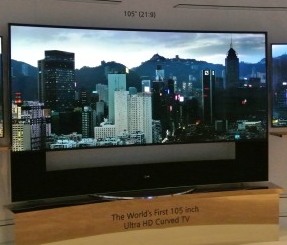
Samsung and others did find ways to do something (potentially) useful with curved displays. The radius of curvature for curved TVs is so large (roughly 15 feet) that it really makes little sense for 55- and 65-inch screens. But Samsung extended the curve by tiling a bunch of these curved screens side to side. Definite applications for digital signage. LG showed a 105-inch curved display. At that size, the claim for curvature offering a more immersive viewing experience has credibility.

LG Displays curved 105-inch OLED-TV is big enough to provide the immersive experience that smaller curved displays do not. (Photo: Ken Werner)
WebOS may finally have found a reason for living as the OS for LG smart TVs. Of the 25 new TV models LG will introduce this year, 56% will have WebOS. Research shows most people think smart TV is too complicated, which inspired LG to position WebOS as the intuitive OS optimized for the Web.
Pixelworks has taken its motion-estimation and motion-compensation (MEMC) chip, which burns 5 watts in TV sets, and produced a very-low-power version for mobile devices. The TV version of the chip is in some LG sets now, and Skyworth has announced another design win for the chip. The video processing chip takes 24 frame-per-second (fps) content and and converts it to 120, thus producing a major improvement in judder. As we spend more time watching video on our small personal screens, we are likely to get impatient with the motion artifacts that have already been dealt with on our living-room TVs. A side-by-side demo in Pixelworks suite was impressive.
It may not be a surprise in principle, but actually seeing the combination of OLED and 4K is VERY impressive.
Not all 4K TVs are beautiful. The 55-inch S1 model from New Century Optronics was truly terrible, with serious comb artifacts (when was the last time you saw a comb artifact?), bad judder, and resolution that looked more like 2K than 4K. At least the U13 model looked like 4K, but it too exhibited serious judder.
Chinese OLED TVs in 2014. Chinese TV giant TCL showed 30.5-inch and 55-inch FHD OLED-TVs. The sets will be launched in China next month, and in the U.S. in Q2 or Q3. The 55-inch has a color gamut of 100% NTSC. A TCL rep said the OLED panel in the 30.5-inch is manufactured by TCL and the panel in the 55-inch is manufactured by a partner. That probably means that the 30.5-inch is produced by China Star Optoelectronics Technology (CSOT), which is a business unit of TCL.
LG Displays OLED manufacturing yield to rise sharply. It is no secret that the manufacturing yields of LGDs OLED TV panels were so low last year estimates were between 10% and 30% that they severely impacted the number of panels that could be produced and kept their cost high. Now, LGD executives tell me the internal yield target for the new OLED plant opening in Q3 is 75%.
Panasonic Lumix hybrid photography. Now that digital still cameras also capture motion video, manufacturers are trying to figure out what what they can do with this combination of abilities. Nikon 1 cameras can bracket a still photo with a short video clip. Panasonics hybrid photography may turn out to be more useful. It produces a largely still image with moving elements: among the demos was a womans still face with softly moving hair. The file should be only slightly larger than a traditional still shot, but still provide motion. Well see how consumers respond.
Perhaps Im easily amused, but I left CES 2014 not only exhausted, but also convinced that there were lots of entertaining surprises to be sniffed out by display bloodhounds.
Ken Werner is Principal of Nutmeg Consultants, specializing in the display industry, manufacturing, technology, and applications. You can reach him at [email protected].