Articles

Living with 4K - Bought an UHDTV? wait, is it Upgradeable?

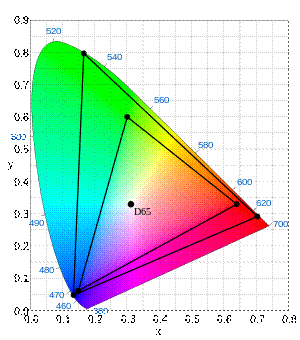
Early UHDTV adopters face potential obsolescence as the ITU Rec. 2020 standard introduces features beyond 4K pixel resolution, including 10/12-bit color depth, 4:2:2 and 4:4:4 chroma subsampling, HDCP 2.2 content protection, and HDMI 2.0 support for 4K at 60fps - capabilities many current displays cannot handle. Most manufacturers offer no upgrade path, while Samsung's replaceable connectivity box and Sony's in-home hardware upgrades for models like the $25,000 VW-1000 projector represent notable exceptions. Buyers should carefully evaluate upgrade commitments before purchasing, as connectivity gaps similar to the HDTV-to-HDMI transition of 1998-2003 could strand millions of early adopters again.

Rodolfo La Maestra
Articles
Living with 4K - Nuvola 4K Player NP-1

Living with 4K - Nuvola 4K Player NP-1

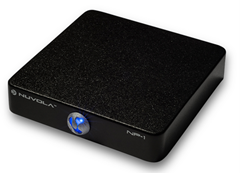
The Nuvola NP-1 is a $299 4K media player powered by an NVIDIA Tegra 4 quad-core processor with 72 GPU cores, running Android 4.2 and featuring a single HDMI 1.4 output limited to 4:2:0 chroma subsampling at 8-bit depth and 24/30 fps. It supports H.264-based 4K streaming and local playback via USB 3.0 storage, with H.265/HEVC support promised via firmware update, but its single-HDMI design forces buyers to use an HDMI splitter or sacrifice multichannel audio. Compared to Sony's $699 FMP-X1, the NP-1 offers broader TV compatibility and lower cost, though its video and audio connectivity limitations have real consequences for home theater installations.

Rodolfo La Maestra
Articles
Kaleidescape Cinema One - Review

Kaleidescape Cinema One - Review

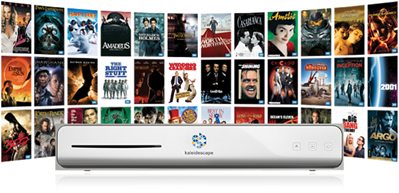
The Kaleidescape Cinema One is a 4TB media server priced at $3,995, capable of storing up to 100 Blu-ray-quality or 600 DVD-quality movies, with bitstream pass-through of Dolby TrueHD and DTS-HD Master Audio over HDMI. Testing against an Oppo reference player in a high-end home theater revealed that a default-enabled detail enhancement setting degraded image quality when used alongside a Darblet video processor, and AACS licensing requires the physical Blu-ray disc to be present during playback of imported titles unless a $3,995 DV700 vault is added. Factoring in hardware amortization, per-movie cost-of-ownership for Blu-ray collectors ranges from roughly $60 to $105 depending on system configuration, making the value proposition heavily dependent on collection size and usage pattern.

Rodolfo La Maestra
Articles
Living with 4K - Here is the 4K Content

Living with 4K - Here is the 4K Content

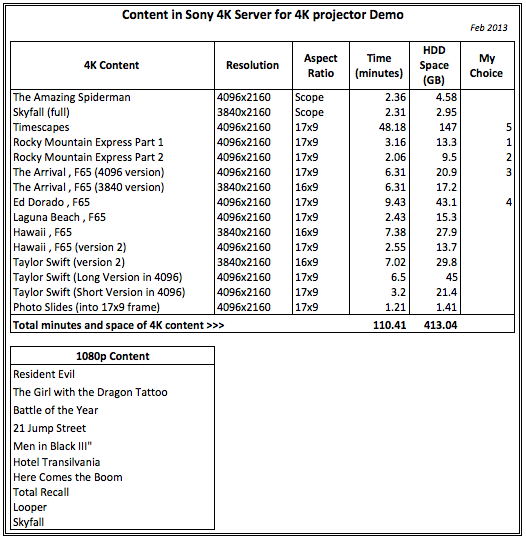
Sony's 4K demo server for projector owners is an HP-based system delivering up to 2 hours of 4K content, including the 48-minute TimeScapes nature film, connected via hi-speed HDMI with only stereo or Dolby 5.1 audio tracks via Toslink. Content is encoded at 8-bit, 4:2:0, Rec-709 color space at 24fps, the same baseline as Blu-ray, leaving the full potential of 4K unrealized in many clips. Viewers evaluating on a 130-inch Stewart Firehawk screen found that well-shot material like the Rocky Mountain Express clips delivered a convincing sense of realism, but inconsistent lighting and compression in other clips made some 4K content indistinguishable from 1080p Blu-ray.

Rodolfo La Maestra
Articles

HDTV Adoption - Not as High in Number of HDTV Sets

CEA data shows 244 million DTVs shipped since 1998, representing 68% penetration of the estimated 357 million TV sets in U.S. households (119 million households at 3 TVs each), yet Leichtman Research Group survey data extrapolates to as many as 198 million analog TVs still in use, or 55% of all sets. The gap between household-level adoption figures (CEA's 68-88%) and actual TV-set-level penetration reveals a more sobering picture of the DTV transition. At the current shipping rate of roughly 33 million DTVs per year, full analog replacement could take 4 to 6 additional years, excluding sets that replace already-digital units.

Rodolfo La Maestra
Articles

3DTV is Not Dead, It's Just Facing Reality Beyond the Hype

The ATSC A/104 Service Compatible Hybrid Coding (SCHC) standard, approved December 2012, defines a 3DTV broadcast framework using MPEG-2 for the base view and AVC/H.264 for the additional view within a single 6MHz terrestrial channel. Europe's Sisvel Technology offers a competing approach via its 3DZ Tile Format, which encodes dual 1280x720p eye images plus a depth map within a single 1920x1080 MPEG-4 frame, leaving roughly 230,400 pixels for auto-stereoscopic data. Both systems prioritize backward compatibility with legacy HDTVs, meaning viewers can receive 3D broadcasts on existing sets without a channel change, though a firmware or hardware update to MPEG-4 set-top-boxes is required for full 3D decoding.

Rodolfo La Maestra
Articles

Living with 4K - Blu-ray Association Evaluating Adding 4K - How to see 4K now

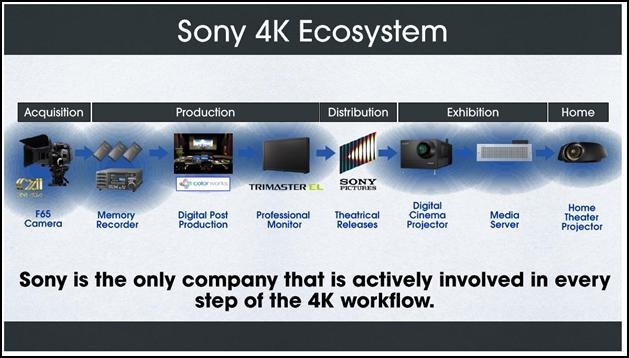
The Blu-ray Disc Association has formed a 'format extension study task force' to evaluate adding 4K, high frame rate, and other technologies to the Blu-ray specification, assessing technical feasibility, market demand, and backward compatibility with existing players. Meanwhile, Sony is demonstrating native 4K content recorded with its F65 camera on dedicated servers, viewable on its $25,000 4K ES projector, with the author noting a perceptible quality difference over upscaled 1080p Blu-ray even at 15 feet on a 10-foot wide Cinemascope screen. For collectors, the prospect of 4K discs - potentially supporting DCI 4K or UHDTV color specs beyond the current 8-bit, 4:2:0, Rec. 709 standard - represents a meaningful upgrade worth watching.

Rodolfo La Maestra
Articles

Living with 4K - No disc? The end of Collecting Movies?

With Red's Redray player ($1,450 MSRP) and Sony's mid-2013 4K media server both relying on download-and-store delivery rather than physical disc formats, the 4K content landscape is shaping up to bypass pre-recorded media entirely. The Blu-ray Association has stated it is not working on a 4K disc standard, echoing the 8-year gap between 1080i HDTV's 1998 debut and Blu-ray's 2006 introduction. For collectors accustomed to owning lossless-quality physical media with full language tracks, subtitle control, and permanent access, a streaming-only 4K ecosystem raises serious concerns about long-term quality and ownership.

Rodolfo La Maestra
Articles
Living with 4K - The REDRAY 4K Digital Cinema Player

Living with 4K - The REDRAY 4K Digital Cinema Player

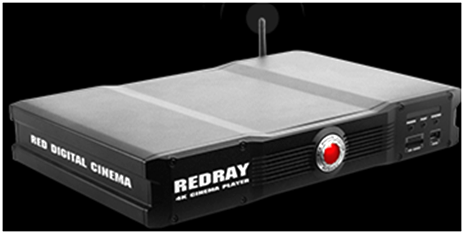
The REDRAY 4K player from RED DIGITAL CINEMA is a download-and-playback device priced at $1,450 that uses a proprietary .RED compression format requiring only 20 Mbps to deliver 4K content, comparable to MPEG-2 HD broadcast bitrates. The player outputs up to 4096x2160 resolution with 12-bit 4:2:2 color, supports 24-bit 7.1-channel LPCM audio at 48 kHz via dual HDMI outputs (1.4 for video, 1.3 for audio), and connects to RED's Odemax distribution platform. For early 4K adopters, this represents one of the only available 4K signal sources, though its content library and audio specs fall short of Blu-ray's 96 kHz or 192 kHz audio capabilities.

Rodolfo La Maestra
Articles
OLED TV Demystified

OLED TV Demystified

LG's 55-inch WOLED HDTV uses a 4-sub-pixel white OLED architecture with color filters and passive 3D at half resolution per eye, priced at $12,000 for Q1 2013 US availability, while Samsung's Super OLED employs a filterless RGB design with active-shutter 3D delivering full resolution per eye. The RGB approach conserves the shorter-lived blue organic material by activating it only when blue output is needed, whereas WOLED continuously drives all sub-pixels to produce white light regardless of the target color. Consumers evaluating these displays should weigh Samsung's potential longevity and wide-angle image quality advantages against LG's near-term market availability.

Rodolfo La Maestra
Articles
Living with 4K (Part 6) - Which 4K? Sony - DCI 4K and Ultra-HD Capable

Living with 4K (Part 6) - Which 4K? Sony - DCI 4K and Ultra-HD Capable

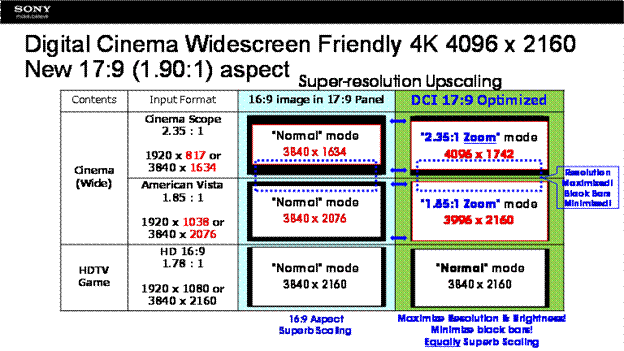
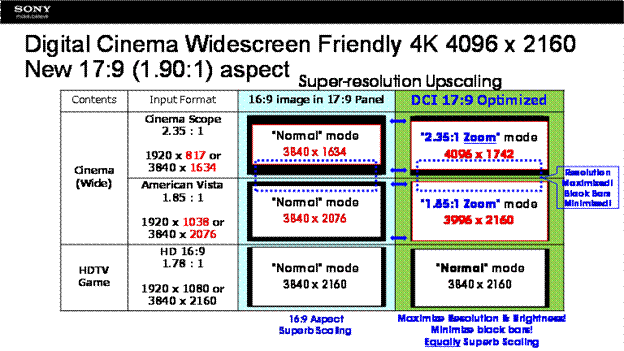
Sony's 4K projector uses a native 4096-pixel DCI 4K chip, displaying 3840x2160 Ultra-HD content via center pixels with 128 unused pixels on each side rather than uneven upscaling, making it genuinely compliant with both DCI 4K and the CEA's Ultra-HD standard. The CEA's adoption of the 3840x2160 'Ultra HD' label introduced naming friction with the broader UHDTV framework already covering 2160p and 4320p formats. Understanding these distinctions matters for buyers evaluating whether a display is a true 4K DCI device or a 16:9 Ultra-HD panel with a different pixel grid.

Rodolfo La Maestra
Articles

Living with 4K (Part 5) - Which 4K ... DCI 4K, Ultra-HDTV, Ultra-HD, Quad-Full-HD?

The CEA's October 2012 Ultra-HD specification defines a minimum display resolution of 3840x2160 at 16:9 aspect ratio, yet omits minimum requirements for bit depth, frame rates, or HDMI 2.0 signal acceptance beyond the current HDMI 1.4 standard's 4K 24/30fps limit. This creates direct nomenclature conflicts with the EBU's UHD-1/UHD-2 framework and the ITU's established Ultra-HDTV standards, which also encompass the 7680x4320 (8K) format. Consumers shopping for next-generation displays face compounding confusion from overlapping terms across DCI 4K, Ultra-HDTV, and Ultra-HD, making it difficult to evaluate whether a product meets any consistent technical benchmark.

Rodolfo La Maestra
Articles
Living with 4K (Part 4) - Which 4K ... DCI 4K, Ultra-HDTV, Ultra-HD, Quad-Full-HD?

Living with 4K (Part 4) - Which 4K ... DCI 4K, Ultra-HDTV, Ultra-HD, Quad-Full-HD?

The DCI 4K standard, published in 2005 by seven major studios, defines a 4096x2160 resolution format using JPEG2000 encoding, 12-bit XYZ color space, and a maximum data rate of 250 Mbit/s, while the ITU-R BT.2020 UHDTV specification sets 3840x2160 and 7680x4320 resolutions with 10/12-bit quantization and up to 120fps progressive scan. These two competing standards use different pixel counts and color spaces, meaning a DCI 4K projector and a consumer Ultra-HDTV display are not interchangeable formats despite sharing the '4K' label. Understanding these distinctions is essential for anyone evaluating 4K display hardware or content pipelines.

Rodolfo La Maestra
Articles
Living with 4K (Part 3) - Which 4K ... DCI 4K, Ultra-HDTV, Ultra-HD, Quad-Full-HD?

Living with 4K (Part 3) - Which 4K ... DCI 4K, Ultra-HDTV, Ultra-HD, Quad-Full-HD?

The Sony VPL-VW1000ES home cinema projector ($25,000 MSRP) uses a true DCI 4K chip with 4096x2160 pixels (17:9 aspect ratio), distinguishing it from consumer Ultra-HDTV panels that offer only 3840x2160 (3.75K by binary measure). Standards bodies including DCI, EBU, ITU, and CEA each define 4K and Ultra-HD differently, creating a fragmented naming landscape that affects how buyers interpret product specifications. Understanding these distinctions matters practically when choosing between a cinema-grade projector and a 16:9 Ultra-HD panel for home use.

Rodolfo La Maestra
Articles
Living with 4K: 4K Content, when? (Part 2)

Living with 4K: 4K Content, when? (Part 2)

Sony's 4K SXRD projector, featuring a 4096x2160 native chip and proprietary Reality Creation upscaling, can deliver a compelling viewing experience even before dedicated 4K content becomes widely available, by intelligently interpolating 1080p Blu-ray sources to near-4K quality. The pending H.265/HEVC standard, promising 50% greater compression efficiency over H.264, is expected to unlock practical 4K distribution and pre-recorded media in the near term. For early adopters, the projector's ability to accept native 4K input, support 12-bit color, and render full 4K resolution per eye in 3D mode makes it a forward-compatible investment worth considering now.

Rodolfo La Maestra
Articles