OLED TVs

HDTV Expert - QD Vision Co-Founder Predicts Death of OLED-TV

QD Vision co-founder and CTO Seth Coe-Sullivan argued at the SID Los Angeles Chapter conference that OLED-TV will become irrelevant within five years, citing quantum-dot-enhanced LCD backlights as capable of exceeding OLED color gamut while consuming less power than OLED panels displaying a white screen. He systematically dismantled eight pro-OLED arguments, noting that mature LCD fabs maintain yield and cost advantages over OLED manufacturing processes such as ink-jet printing and OVJP, which have proven harder to scale than anticipated. For consumers, this suggests that quantum-dot LCD televisions - already appearing in 2013 Sony and Amazon Kindle Fire HDX products - may deliver premium picture quality at lower prices than OLED alternatives.
Ken Werner
Columns
HDTV Expert - Display Surprises at CES 2014

HDTV Expert - Display Surprises at CES 2014

CES 2014 surfaced several notable display advances, including 3M's Quantum Dot Enhancement Film (QDEF) deployed in the Kindle Fire HDX 8.9-inch tablet, boosting color gamut from 60% to 72% NTSC while substantially improving battery life. Sharp demonstrated an HDR TV prototype using Dolby professional monitor technology, potentially targeting consumer pricing by 2015, and LG disclosed an internal yield target of 75% for its new OLED TV panel plant opening in Q3. For consumers, these developments signal meaningful near-term improvements in display quality, power efficiency, and OLED availability across price tiers.

Ken Werner
Columns
HDTV Expert - CES 2014 In The Rear-View Mirror

HDTV Expert - CES 2014 In The Rear-View Mirror

CES 2014 showcased a wave of 4K LCD and OLED televisions, with HEVC H.265 encoding poised to halve required bit rates and enable 4K streaming at roughly 10-20 Mb/s over existing broadband infrastructure. Quantum dot film technology, already deployed in Sony's 55-inch and 65-inch 4K LCD TVs, offers a compelling alternative to OLED by delivering stable, narrow-bandwidth color without the differential blue-emitter aging that threatens OLED longevity beyond 5,000 hours. Consumers weighing early adoption of these technologies will find the display interface landscape still evolving, with HDMI 2.0 capped at 18 Gb/s and DisplayPort 1.3 promising higher headroom for 10-bit 4K at 60 Hz.

Pete Putman
Columns

HDTV and Home Theater Podcast - Podcast #618: Best of CES 2014 and Top Tech to Watch this Year

Podcast episode 618 recaps home theater highlights from CES 2014, covering award winners across Digital Trends, Engadget, and CES Innovations categories, including the LG 77-inch Curved Ultra HD OLED TV (77EC9800) and Sony FMP-X1 4K Ultra HD Media Player pre-loaded with 10 feature films. Notable audio picks include the Philips Fidelio E5 wireless 5.1 surround system and Bang and Olufsen BeoLab 18, while the Samsung UN65H7150 touts a Real 240Hz Full HD panel with quad-core processing. Consumers tracking display and audio upgrades in 2014 will find a concise cross-source roundup of the year's most significant product launches.

The HT Guys
Podcasts
HDTV Expert - CES 2014: First Impressions (4K, Curved Screens, OLEDs, and All That)

HDTV Expert - CES 2014: First Impressions (4K, Curved Screens, OLEDs, and All That)

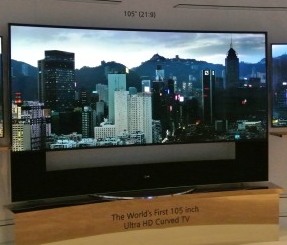
CES 2014 brought a wave of large-format display technology, highlighted by three manufacturers unveiling 105-inch 21:9 curved 4K LCD TVs, LG's 77-inch curved 4K OLED as the world's largest, and Vizio's 120-inch 4K LCD using Sharp's Gen 10 ASV glass from Sakai, Japan. Chinese manufacturers replicated nearly every Samsung and LG breakthrough with far less fanfare, while Panasonic's conspicuous absence of a consumer LCD lineup signals a potential exit from the TV market. For buyers, the practical takeaway is that large 4K LCDs are on track to become the standard within 2-3 years, with competitive pricing pressure accelerating from Chinese brands.

Pete Putman
Columns

HDTV and Home Theater Podcast - Podcast #600: IFA 2013

IFA 2013 brought a wave of next-generation display announcements, headlined by LG's 77-inch Ultra HD Curved OLED TV combining WRGB OLED technology with 4K resolution for an infinite contrast ratio, and Samsung's 98-inch 4K OLED priced above the $40,000 mark. Harman Kardon debuted the Onyx, a 60W Bluetooth and AirPlay wireless speaker at $650, while Sony unveiled the KDL-65S990A, a 65-inch curved 1080p HDTV with an eight-speaker four-channel audio system for $4,000. For home theater enthusiasts, the show previewed where premium display and audio hardware is heading, though practical value remains limited by steep pricing.

The HT Guys
Podcasts

HDTV Expert - Samsung and LG Offer Curved OLED TVs - but Why?

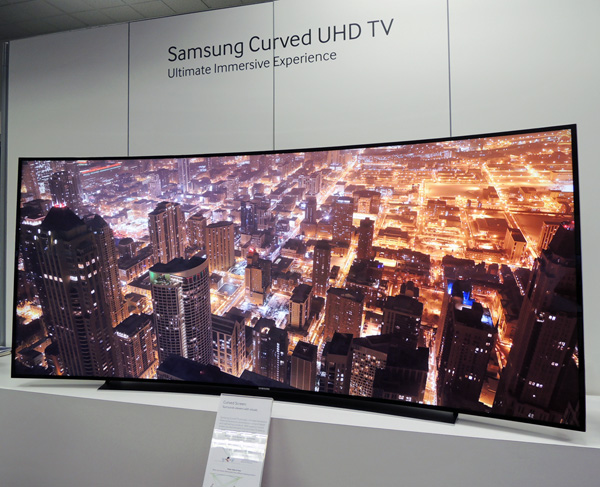
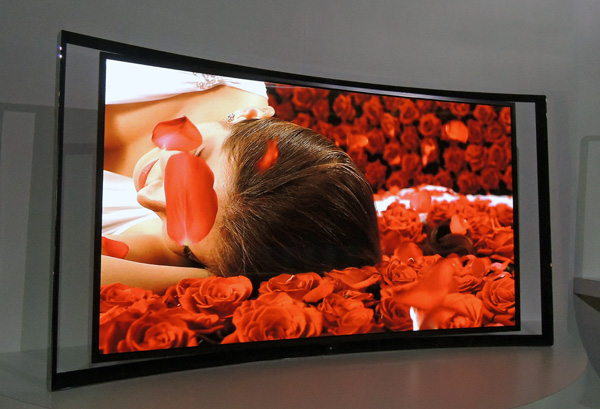
Samsung and LG have begun shipping 55-inch curved OLED TVs at prices of $8,999 and $14,999 respectively, with LG's panel featuring a 5,000 mm radius of curvature - well beyond the typical 8-foot viewing distance. Geometric analysis confirms LG's claims of improved horizontal viewing angle and color uniformity are technically valid, though the flat-screen equivalent would need only about one inch of additional width to match the curved display's included viewing angle. The practical takeaway is that the benefits are real but marginal, and the curved form factor appears driven more by manufacturing optics and marketing than by meaningful display science.

Ken Werner
Columns
HDTV Expert - Guess What, LG? Samsung's Got a 55-inch Curved OLED TV, Too.

HDTV Expert - Guess What, LG? Samsung's Got a 55-inch Curved OLED TV, Too.

Samsung's KN55S9C enters the OLED TV market as a 55-inch curved display priced at $8,999.99, undercutting LG's $15,000 curved OLED by using RGB OLED emitters rather than LG's white-OLED-plus-color-filter design. The panel features a dual dark-blue pixel layout with brightness compensation circuitry to address differential aging, a known challenge in OLED longevity. Samsung also demonstrated MultiView, which exploits OLED's fast pixel switching at 120/240 Hz to deliver two simultaneous programs via active shutter glasses, making this a technically ambitious debut worth watching closely.

Pete Putman
Columns

HDTV and Home Theater Podcast - Podcast #589: SID Display Week 2013

Coverage of SID Display Week 2013 highlights three emerging display technologies with significant market implications. LG demonstrated a 5-inch flexible, unbreakable plastic-substrate OLED panel that attendees could hammer and twist, while 3M and Nanosys announced Quantum Dot Enhancement Film (QDEF) promising a 50% wider color gamut than existing LCD backlights at zero additional manufacturing cost. Shinoda Plasma Co. won Best Prototype for a rollable full-size plasma panel using 1mm glass tubes, suggesting that durable, flexible, and color-accurate displays could reshape both portable devices and home theater installations.

The HT Guys
Podcasts
HDTV Expert - LCD Always Wins

HDTV Expert - LCD Always Wins

Quantum-dot-enhanced backlights, already available in Sony's Triluminous TVs using QD Vision's Color IQ optical element, deliver OLED-like color gamut at a price premium estimated around $300 per set. At SID Display Week 2013, 3M also announced volume production of its Quantum Dot Enhancement Film (QDEF), targeting small to medium-size screens including potential 1920x1080 smartphone panels. These developments suggest LCD could close the image quality gap with OLED-TV before large-screen OLED manufacturing yields become commercially viable, potentially repeating the historical pattern of LCD neutralizing rival display technologies.

Ken Werner
Columns

HDTV and Home Theater Podcast - Podcast #583: OLED vs 4K for your next TV

OLED and 4K (UHD) are competing for the title of next major TV technology, with OLED delivering superior color and contrast even at 1080p resolution but priced at roughly $10,000 to $13,500 for a 55-inch panel, while 4K sets like the Seiki 50-inch are available now starting at $1,445 yet offer only a resolution upgrade with no dedicated over-the-air broadcast standard or Blu-ray support. The practical takeaway is that neither technology is ready for most buyers today, making a 1080p Panasonic Plasma the more sensible near-term purchase while OLED matures and 4K content infrastructure catches up.

The HT Guys
Podcasts
HDTV Expert - The Wacky World of OLEDs

HDTV Expert - The Wacky World of OLEDs

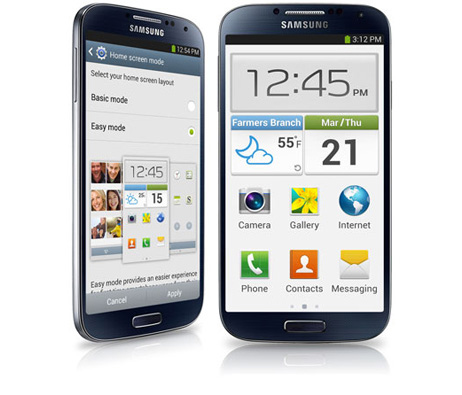
Samsung's Galaxy S4 features a Full HD, 440 ppi, 5-inch AMOLED display that has earned strong reviews, while Displaybank data shows 88.4% of OLED shipments in Q4 2012 were 4 inches or larger, confirming a mature small-screen market. Large-screen OLED TV, however, remains commercially marginal, with LG's curved 55-inch set launching in Korea above $13,000 and flat 55-inch OLED production still in the low hundreds. Manufacturers are pivoting to 4K x 2K LCD-TV as a more immediately scalable path to premium display sales.

Ken Werner
Columns
HDTV Expert - For Samsung, It's Now Their Game With Their Rules

HDTV Expert - For Samsung, It's Now Their Game With Their Rules

Samsung, controlling roughly 25% of the global TV market and manufacturing over 90% of OLEDs used in handheld displays, announced a $111 million investment in Sharp Corporation for a 3% ownership stake, a move that signals a strategic pivot away from commodity LCD panel production toward next-generation IGZO backplane and OLED technology. Sharp, facing a record 450 billion yen ($4.7B) annual loss and a 55% stock price decline, had been courted by Taiwan-based Foxconn Group, making Samsung's entry a geopolitically significant shift in Asian CE industry dynamics. For consumers and industry watchers, this consolidation suggests Samsung is positioning itself to control both display supply chains and the transition to large-screen OLED technology.

Pete Putman
Columns

HDTV Expert - OLED-TV, Where are You?

LG's 55-inch OLED-TV, priced at roughly $12,000 in the U.S., faces serious production constraints as manufacturing yields at LG Display reportedly hover around 10%, with a target of 30% after defect repair - figures that will keep prices elevated for years. LG's planned Gen 8 OLED fab in Paju, with a monthly input capacity of 26,000 sheets, is not expected to reach mass production until H1 2014. Meanwhile, Panasonic and Sony each debuted 56-inch 4K OLED-TVs at CES 2013 using AUO Gen 6 backplanes, with Panasonic employing a printed front-plane process that could eventually reduce costs more aggressively than Sony's vacuum thermal evaporation approach.

Pete Putman
Columns

HDTV Expert - Panasonic Delivers Big OLED Surprise at CES - by Ken Werner

Panasonic stunned CES attendees with a 56-inch 4K (4Kx2K) OLED-TV panel fabricated using solution-based printing technology, marking the first large solution-processed OLED display shown publicly and a potential breakthrough for cost-competitive large-screen OLED production. Samsung and LG both debuted curved 55-inch OLED-TVs, each claiming a world-first, though the practical value of screen curvature for OLED remains questionable given the technology's already wide viewing angles. LG also confirmed its flat 55-inch OLED-TV would go on sale in the U.S. in March, its fourth announced commercial release date.

Pete Putman
Columns