


Living with 4K (Part 6) - Which 4K? Sony - DCI 4K and Ultra-HD Capable
- Living with 4K: Getting the Beautiful Monster (Part 1)
- Living with 4K: 4K Content, when? (Part 2)
- Living with 4K (Part 3) - Which 4K ... DCI 4K, Ultra-HDTV, Ultra-HD, Quad-Full-HD?
- Living with 4K (Part 4) - Which 4K ... DCI 4K, Ultra-HDTV, Ultra-HD, Quad-Full-HD?
- Living with 4K (Part 5) - Which 4K ... DCI 4K, Ultra-HDTV, Ultra-HD, Quad-Full-HD?
- Living with 4K (Part 6) - Which 4K? Sony - DCI 4K and Ultra-HD Capable
Parts 3, 4 and 5 of this “Living with 4K series covered the various naming conventions and standards regarding 4K and Ultra-HDTV. Part 5 summarized the subject with CEA's naming the new 3860x2160 displays as Ultra-HD. However, Sony responded by insisting in using also the 4K designation for their future products. Some say: why? I say: no wonder why.
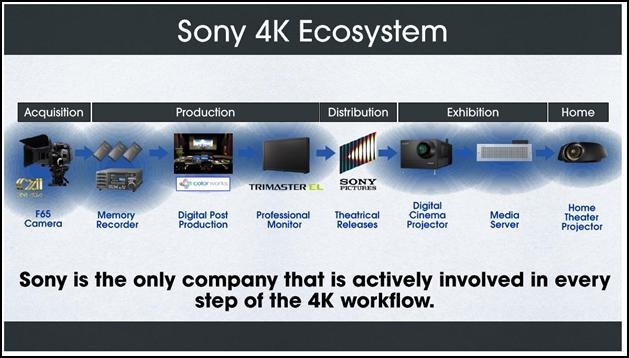
I see no problem in Sony continuing the use of the 4K nomenclature for a true 4K product that came first to market as part of a long effort and dedication of manufacturing quality 4K products since 2005 for professionals and now for consumers, including content, cameras, production equipment, and displays, a coverage from image acquisition to display that no one else was able to match.
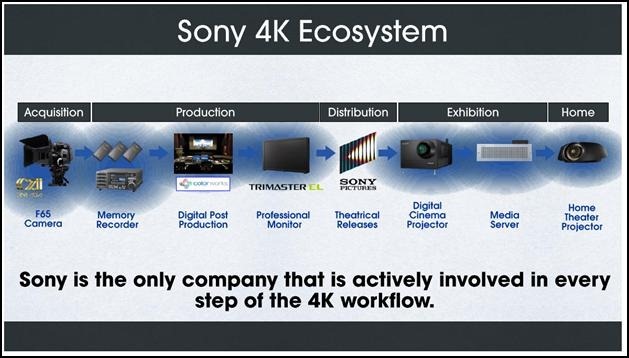
Source: Sony
If there is a risk of some naming confusion it has been actually brought by the CEA when creating the “Ultra HD (UHD) name for 3840x2160 panels, a name that is so similar to the broad “Ultra HDTV (UHDTV) naming convention that was already in place to engulf 2160p (loosely called 4K) and 4320p (loosely called 8k) video formats.
I understand why the CEA may have needed a more user/marketing friendly naming convention for the new higher resolution displays, a name better than the already established “U-HD1, or “lower level U-HDTV, or “level one of U-HDTV or “so-called 4K, etc.
Those displays are more in tune with the existent HDTV 16:9 aspect ratio and allow for a cleaner upscaling considering that a 1920x1080 HDTV image is evenly doubled by upscaling it horizontally and vertically to 3840x2160, and a 1280x720p HDTV image is evenly tripled to its 3840x2160 upscaled version.
However, as mentioned in parts 1 and 3, the Sony 4K projector, a true 4K display device, does not unevenly upscale the 1920 horizontal pixels of a 16:9 HD image to the 4096 horizontal pixels of its 4K 17:9 chip, but rather uses the center pixels of the chip to display the 3840x2160 image with pillars of 128 unused pixels on each side.
 In other words, Sony's 4K projector is actually a 4K product that deserves the 4K name, not just the U-HD name, and also implements the best scenario for cleanly upscaling 16:9 legacy HDTV content, and to accept and display a U-HD source and even a 4K DCI 17:9 content, when available to consumers from the many 4K theatrical releases.
Some criticized Sony for adding the 4K term to the U-HD term created by the CEA, but quite frankly, why should Sony refrain from using the 4K naming for their true 4K product/s introduced years before anyone else in the market, and truly comply with the 4K standard, in addition to be capable of handling the 3840x2160 UHD1 format of Ultra HDTV?
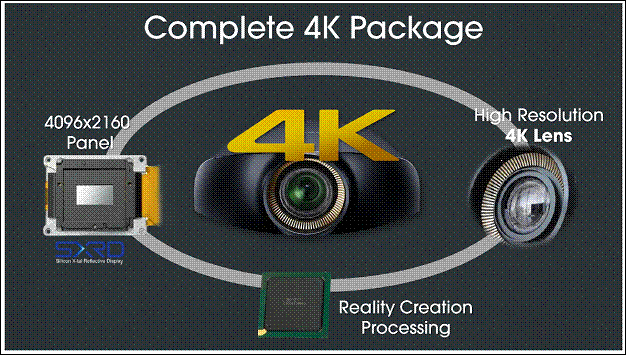
Source: Sony
My view also applies to any other manufacturer of true 4K products that desire to continue using 4K nomenclature for equipment that is actually 4K DCI capable, regardless how they may also comply with the Ultra-HDTV standard.
On the other hand, I disagree with Sony (or any other manufacturer) if it decides to continue using the 4K term for also a 16:9 Ultra HD panel (such as Sony's and LG's 84" Ultra-HD panels) with a resolution of 3840x2160, and not be compliant with true 4K DCI.
To Sony's credit, the company showed the effort to compete in the U-HD 16:9 panel market and also to share the 3D passive displays marketplace for their first time, like Panasonic did this year as well (all Sony's other 3DTVs and 3D projectors are active shutter based, including their new 4K projector). These appear to be logical company decisions that are made to survive and compete in the very difficult TV market of the past few years.
Stay tuned to part 7 of this “Living with 4K series