
articles
2005 HDTV Report, Part 1: CES Highlights
This is the first in a series of articles taken from the H/DTV Technology Review & CES 2005 Report by Rodolfo La Maestra, published in March 2005. If you are interested in downloading the full version of this report, it is currently available for purchase from our CES Report page.
During the Year, Before CES
The High Definition DVD format wars and the Hollywood Studios showing their non-exclusive support to either side have started to become more public, and worrisome. The first large LCD panels were shown last year at CES 2004, and by year-end 1.4 million LCD panels were sold; 290,000 LCD panels were sold in October alone. 2004 was also the starting year of the market attraction for panels. 2004 also showed considerable public interest in H/DTV with 7 million sets sold, 14 million sets were sold in total since November 1998, representing 23 billion dollar sales; 4 million of those were sold on the first four years (99-02), another 3 million in 2003. In summary, 2004 sold the same as 99-03 together. The last two years were remarkable for the growth; it appears that consumers are becoming more interested in H/DTV for the purpose of watching TV, not as the interest of early adopters in experimenting with the groundbreaking technology between 1998-2002.After CES
CES showed that 2005 will be the year when 1080p display started to compete. Perhaps, content and distribution will equally be motivated to reach that level of quality, such as Hi Def DVD for late 2005 / early 2006. More efficient compression algorithms like MPEG-4 AVC are making possible not only High Definition DVD, but also the expansion of HD satellite services and more HD channels, as it was recently announced by DIRECTV, Dish Network, and Voom. Should quality be an objective (rather than multicasting DTV SD channels), the more efficient MPEG-4 compression has the potential to facilitate the distribution of 1080p content (at 60 frames x second) using a similar bandwidth allocated for today's 1080i (30 frames per second interlaced as 60 fields). Although the ATSC standard does not include that level of quality, the potential could be applied for other services than over-the-air. New 1080p sets, if designed to accept a 1080p signal, would be in a good position to display at that potential. Read more in the highlights and later on the report. In 2005, panel prices will come down at a faster rate relative to other types of displays, and panels will be more common at larger sizes, such as 70+ and 80-inches plasmas, and even a oversized 102" model expected within two years. LCD panels are joining the 40" plus domain of the plasmas, with 40 to 65 inches from many manufacturers. CES unveiled a good number of these oversized panels. HD-DVRs are becoming to appear integrated within some TVs and plasmas, small portables, in addition to HD-STBs for cable, over the air, and satellite. The report includes a large number of new products and technologies; the following pages are just a highlight of CES 2005: LCD-TV Panels will be coming in 57" from Samsung, TTM Jun 05 ($16000), 1920x1080p, integrated with ATSC/QAM CableCARD tuners, 1000:1 CR, DNIe, AnyNet home-networking, 600 cd/m2 brightness, 6.2 million color capacity, response time faster than 8 ms, an improvement from the 12 ms of their 46" model 468W introduced 6 months ago, not to mention the comparable improvement over the 20ms+ of many other LCD products.

|

|
| Samsung 57" LCD-TV | |
Below, LG's 55" LCD RU-55LP10, $TBA, TTM May 05, 1080p, ATSC/QAM/NTSC tuners.
|
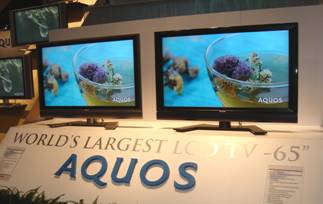
 Sharp AQUOS 65" LCD-TV |

|

|
| Sony Black Screen HCS-W80 | |
 TI built and calibrated their demo set (left) as a demonstration of the level of quality that other manufacturers could also reach using the xHD3 technology, if also using good optics, engines, color wheel, etc.
JVC's D-ILA produced crisp images with excellent blacks, whites, good rendering of all colors, well resolved image, and faithful to fast motions of dynamic scenes.
TI built and calibrated their demo set (left) as a demonstration of the level of quality that other manufacturers could also reach using the xHD3 technology, if also using good optics, engines, color wheel, etc.
JVC's D-ILA produced crisp images with excellent blacks, whites, good rendering of all colors, well resolved image, and faithful to fast motions of dynamic scenes.
 The Samsung 70" DLP set to the left was also shown in an open area.
 The Sony SXRD on the right was shown in a large open room; it appeared as the contrast, sharpness, and edge enhancements were excessive; some artifacts could be attributed to the source material.
 It seemed that the Sony set was not ISF calibrated, and that it could have shown better in a more appropriate environment; the set deserves another viewing opportunity. Sony includes this set now as part of the QUALIA line for $13,000; the set was initially introduced a few months ago as part of the XBR line for $10,000.
 A 1080p vs. 720p demonstration was made by Samsung (left). New 1080p TVs include proprietary de-interlacers that usually are not as good as external scaler/video processors. Considering that in the near future there might be 1080p sources, such as High Definition DVD for film content, the feature of accepting a 1080p input might become important for a TV of this level at that time. Accepting 1080p externally will also permit the connection of a higher-quality 1080p video processor, such as Faroudja, DVDO HD+, and Lumagen video processors, or the soon to be available "Dragon Fly" scaler/noise reduction processor. The unit implements the new Silicon Optix/Teranex "Realta" HQV (Hollywood Quality Video) chip, a programmable DSP that can perform one trillion operations per second.
The new HQV chip upconverts 1080i to 1080p at up to 120 fps, has received four awards since its introduction in 4Q04, and the Best of Innovations CES 2005 award. The technology HQV was developed by Teranex, a company that was later acquired by Silicon Optix. HQV has been used in professional products costing $60,000 and up. It employs pixel-by-pixel processing, scaling, detail enhancement, and is fully programmable and capable to receive future firmware upgrades.
Ray Lego, Product Manager of Teranex Business Unit at Silicon Optix Inc, and by Menno Stoffels, Director of Systems Engineering of Silicon Optics Canada Inc. demo the product with impressive results on video comparisons at CES 2005.
A 1080p vs. 720p demonstration was made by Samsung (left). New 1080p TVs include proprietary de-interlacers that usually are not as good as external scaler/video processors. Considering that in the near future there might be 1080p sources, such as High Definition DVD for film content, the feature of accepting a 1080p input might become important for a TV of this level at that time. Accepting 1080p externally will also permit the connection of a higher-quality 1080p video processor, such as Faroudja, DVDO HD+, and Lumagen video processors, or the soon to be available "Dragon Fly" scaler/noise reduction processor. The unit implements the new Silicon Optix/Teranex "Realta" HQV (Hollywood Quality Video) chip, a programmable DSP that can perform one trillion operations per second.
The new HQV chip upconverts 1080i to 1080p at up to 120 fps, has received four awards since its introduction in 4Q04, and the Best of Innovations CES 2005 award. The technology HQV was developed by Teranex, a company that was later acquired by Silicon Optix. HQV has been used in professional products costing $60,000 and up. It employs pixel-by-pixel processing, scaling, detail enhancement, and is fully programmable and capable to receive future firmware upgrades.
Ray Lego, Product Manager of Teranex Business Unit at Silicon Optix Inc, and by Menno Stoffels, Director of Systems Engineering of Silicon Optics Canada Inc. demo the product with impressive results on video comparisons at CES 2005.
 The chip will be offered to interested manufacturers. According to Mr. Michael Poirier, VP of Sales and Marketing of Algolith, the manufacturer of the "Mosquito" product, the company is working to release a scaler/noise reduction processor mentioned above by Jun/Jul 05 at a $3499 MSRP. The unit outputs 1080p/60 frames x second (from 480i to 1080i inputs), but would probably output also 24 and 30fps, if added into the design by the time the unit is released to the market.
The High Definition DVD war is warming up and CES has shown units from most major companies, such as JVC, LG, Panasonic, Philips, Pioneer, Samsung, Sharp, and Sony with their HD Blu-ray DVD ROM players and BD-RE recorders/players; and Toshiba and Sanyo their HD DVD format versions.
Over the last 4 years, many prototypes were shown at CES but no production unit was released within the US market yet, although there are three released in Japan already, and several in China using the EVD format (among other formats they have). Most HD DVD and Blu-ray manufacturers are now announcing that their products will be introduced by year-end 2005 or early 2006.
Regarding component analog outputs, no confirmation was provided if they would be allowed to carry 1080i HD in addition to DVI and HDMI, the preferred secured uncompressed HD connection. Nor was confirmed if 1080p would be implemented on discs and players, however, most High Definition DVD companies at CES stated that content originating from film would most probably be recorded as 1080p/24fps in the Hi Def pre-recorded discs, but that decision would be made by the content providers.
Actually, the content would probably be stored as 1080i interlaced with flags to reconstruct the progressive cadence of film for progressive output connections, similar to the technique of regular DVD for 480i and 480p with film content.
The chip will be offered to interested manufacturers. According to Mr. Michael Poirier, VP of Sales and Marketing of Algolith, the manufacturer of the "Mosquito" product, the company is working to release a scaler/noise reduction processor mentioned above by Jun/Jul 05 at a $3499 MSRP. The unit outputs 1080p/60 frames x second (from 480i to 1080i inputs), but would probably output also 24 and 30fps, if added into the design by the time the unit is released to the market.
The High Definition DVD war is warming up and CES has shown units from most major companies, such as JVC, LG, Panasonic, Philips, Pioneer, Samsung, Sharp, and Sony with their HD Blu-ray DVD ROM players and BD-RE recorders/players; and Toshiba and Sanyo their HD DVD format versions.
Over the last 4 years, many prototypes were shown at CES but no production unit was released within the US market yet, although there are three released in Japan already, and several in China using the EVD format (among other formats they have). Most HD DVD and Blu-ray manufacturers are now announcing that their products will be introduced by year-end 2005 or early 2006.
Regarding component analog outputs, no confirmation was provided if they would be allowed to carry 1080i HD in addition to DVI and HDMI, the preferred secured uncompressed HD connection. Nor was confirmed if 1080p would be implemented on discs and players, however, most High Definition DVD companies at CES stated that content originating from film would most probably be recorded as 1080p/24fps in the Hi Def pre-recorded discs, but that decision would be made by the content providers.
Actually, the content would probably be stored as 1080i interlaced with flags to reconstruct the progressive cadence of film for progressive output connections, similar to the technique of regular DVD for 480i and 480p with film content.
 Toshiba HDD + HD DVD Recorder |
 JVC Blu-ray DVD Combo ROM |
 Voom HD-STBs (580 and 550) will be MPEG-4 upgradeable via a Voom supplied card that would be inserted on a slot accessible by opening a small plastic door on its right side. Further MPEG-4 software upgrades would be seamlessly installed as firmware downloads sent thru the satellite dish.
The small client STBs linked to the 580 server DVR using the coax network will not be available until later in 2005, after the DVR 580 is introduced; however, according to Voom, the current Motorola's 550 STBs can operate as network clients controlling the 580 DVR functions remotely. The recent sale of some of Voom's assets to Dish Network could potentially affect the plans of new products, additional satellites and channels, and MPEG-4 upgrade.
Dish Network announced the future release of a new HD DVR STB, but also confirmed the discontinuation of the famous PVR-921 and the company plans for IEEE1394 connections, a key feature announced over the past 3 years, and a reason many consumers endured the long waiting.
After the PVR921 introduction in 2004, the IEEE1394 feature was never activated as promised; the feature would have permitted D-VHS tape archival of the HD-DVR's stored or tuned satellite content. The omission of IEEE1394 situates Dish Network on the ranks of Voom and DirecTV regarding that capability, giving an edge to Cable and OTA HD-STBs, which do have IEEE1394 outputs for the archiving of permitted content (under DTCP protection rules).
Voom HD-STBs (580 and 550) will be MPEG-4 upgradeable via a Voom supplied card that would be inserted on a slot accessible by opening a small plastic door on its right side. Further MPEG-4 software upgrades would be seamlessly installed as firmware downloads sent thru the satellite dish.
The small client STBs linked to the 580 server DVR using the coax network will not be available until later in 2005, after the DVR 580 is introduced; however, according to Voom, the current Motorola's 550 STBs can operate as network clients controlling the 580 DVR functions remotely. The recent sale of some of Voom's assets to Dish Network could potentially affect the plans of new products, additional satellites and channels, and MPEG-4 upgrade.
Dish Network announced the future release of a new HD DVR STB, but also confirmed the discontinuation of the famous PVR-921 and the company plans for IEEE1394 connections, a key feature announced over the past 3 years, and a reason many consumers endured the long waiting.
After the PVR921 introduction in 2004, the IEEE1394 feature was never activated as promised; the feature would have permitted D-VHS tape archival of the HD-DVR's stored or tuned satellite content. The omission of IEEE1394 situates Dish Network on the ranks of Voom and DirecTV regarding that capability, giving an edge to Cable and OTA HD-STBs, which do have IEEE1394 outputs for the archiving of permitted content (under DTCP protection rules).
 The new DVR is the Dish Player DVR942 (left), $700 with additional $50 for the dish, TTM Feb 05, 250GB HDD capable of recording up to 25hrs of HD content, or 180 hrs of SD. It features a dual tuner satellite receiver with 2 TV outputs for multi-room viewing, up to 9 days EPG, records Dolby Digital audio, has an ATSC tuner to record OTA, caller ID with history, 2 USB ports for future use, optical audio out, DVI/HDCP, and component YPbPr outputs. The STB is to be offered also for lease at $250 initiation fee (the subscriber must return the box at the end of the service).
 To mate the DVR942 Dish Network also announced a couple of portable DVRs (right) that can store in their 20GB and 40 GB memories the content transferred from the DVR942, although at SD resolution. The content cannot be output, is user erasable, and can be played back on their small screens (sizes of 2.2, 4, and 7-inches). Some units feature inputs of Compact Flash cards, IEEE1394, and USB 2.0 to receive the content.
 Scientific Atlanta also showed a prototype of a new STB server DVR model, a networking centerpiece that can connect with other STBs from the company via coaxial cable. The DVR (model # pending) has a planned release of late 2005, and will be capable of archiving HD content as a file copy format within a Hi Def DVD disc using an internal recorder. The disc would also be playable on similar models, but not on other players of Hi Def DVD formats (such as Blu-ray or HD DVD). The STB has a QAM Cable tuner (with expected Cable CARD capability when released) and will be available for distribution via cable companies only; it features IEEE1394, 160GB, and also records DVD-R/-RW dual layer 8.5 GB discs playable on regular DVD players, if the content is unprotected.
 Samsung, LG, and Toshiba introduced a new technology that allows a CRT direct-view tube to be manufactured with 30% less depth, Samsung calls it "SlimFit" and already announced a new line of sets called "DynaFlat SlimFit CRT direct-view TV Series", the first set of that line will be a 30" TX-R3079WH, $1,300, TTM Mar 05, 15.5 inches deep, w/integrated ATSC tuner. LG also announced a similar 30" ATSC integrated set for later 2005.
New lines of CRT sets were introduced by several companies, Thomson in particular announced seven new sets w/ATSC tuners that display 480i SD, intended for second rooms; its 27" integrated entry level will be offered at just $269. The company also announced a new line of CRT based RPTVs with ATSC integrated tuners at a price starting at $1,100 (52", 56" and 61" screen sizes).
If you are into video games, you might have interest on a 3-D projection system designed for that purpose; a 3-D RPTV prototype demonstration from LG was shown at CES as a technology statement using a Stereoscopic Projection System. Check the LG displays group for details. Radio Shack and Sears introduced their own HDTV sets in DLP and LCoS respectively, look into the corresponding sections for specifications, prices, and availability.
Regarding large plasma panels, Samsung introduced large plasmas up to 80 inches (HPR8072, $39,000, 1920x1080p, TTM May 05, integrated ATSC/QAM Cable CARD tuners) and a 102" prototype model announced as the largest TV in the world (Z102, 1920x1080, TTM two years, $80,000-$90,000 estimated MSRP)
Samsung, LG, and Toshiba introduced a new technology that allows a CRT direct-view tube to be manufactured with 30% less depth, Samsung calls it "SlimFit" and already announced a new line of sets called "DynaFlat SlimFit CRT direct-view TV Series", the first set of that line will be a 30" TX-R3079WH, $1,300, TTM Mar 05, 15.5 inches deep, w/integrated ATSC tuner. LG also announced a similar 30" ATSC integrated set for later 2005.
New lines of CRT sets were introduced by several companies, Thomson in particular announced seven new sets w/ATSC tuners that display 480i SD, intended for second rooms; its 27" integrated entry level will be offered at just $269. The company also announced a new line of CRT based RPTVs with ATSC integrated tuners at a price starting at $1,100 (52", 56" and 61" screen sizes).
If you are into video games, you might have interest on a 3-D projection system designed for that purpose; a 3-D RPTV prototype demonstration from LG was shown at CES as a technology statement using a Stereoscopic Projection System. Check the LG displays group for details. Radio Shack and Sears introduced their own HDTV sets in DLP and LCoS respectively, look into the corresponding sections for specifications, prices, and availability.
Regarding large plasma panels, Samsung introduced large plasmas up to 80 inches (HPR8072, $39,000, 1920x1080p, TTM May 05, integrated ATSC/QAM Cable CARD tuners) and a 102" prototype model announced as the largest TV in the world (Z102, 1920x1080, TTM two years, $80,000-$90,000 estimated MSRP)
 Samsung 80" Plasma HPR8072 |
 Samsung 102" Plasma Z102 |

|

|

|

|

|

|
 Although showing an increase from last CES 2004, CES 2005 introduced only a few future A/V receivers with such feature, and those are still top-end (and expensive) models. Some from Denon ($3000 to $6000), Integra Research ($4000), JVC ($3500), Samsung ($5000), etc. Check the details and specifications of those new products, and some of the DVD upconversion players with HDMI and DVI capabilities on the same section later in the report.
Read the coverage about the Broadcast Flag content protection mandate by the FCC; how is being implemented, and what systems were included within the 13 digital content protection technologies approved by the FCC so far, such as CPRM (4C for SD sources), D-VHS (JVC), VCPS (Vidi, developed by Philips and HP for recording DTV broadcast into DVD+R/RW discs), etc.
The report also has a dedicated section to cover the subject of how integrated DTVs that include a QAM CableCARD tuner actually operate only with uni-directional capabilities, which could force a consumer to lease a (bi-directional) HD-STB to been able to use the services of Video-On-Demand (VOD), Impulse-Pay-Per-View (ordering PPV movies using the remote, rather than the phone), and Cable company's Electronic Program Guide (EPG).
In summary, depending how a consumer receives the HD signals, he/she might be forced to pay for redundant or duplicated tuners; most consumers would not have enough information to notice were their additional money went on the integrated solution, unless they read reports like this one.
Check also in the report, how tuner integration is being implemented to comply the mandate of the FCC. CES has shown a massive effort from manufacturers in installing ATSC and QAM Cable CARD tuners in most large TV sets, and it will become unusual to find a monitor version when you find the DTV set you like. As covered in my earlier articles, the price of integrated tuners is expected by most in the industry to come down considerably and soon, but unfortunately, the 2005/6 lines are not showing a considerable drop yet.
There was an average $704 extra on the 2004/5 lines announced a year ago, and is now in the $500 range on the 2005/6 lines. Samsung announced in 2004 that their integrated versions (Series 67 expected for Apr 05) would be priced $500 above the monitor versions (Series 63 released in Jun 04), and Toshiba showed a mark up of $400 for the integrated tuners on some of their newer models.
On the other hand, as mentioned above, Thomson was able to introduce a 480i SD integrated 27" TV with an ATSC tuner for just $269 MSRP. Granted the integrated tuner outputs only 480i SD for the TV to operate at that resolution, but for the tuner to be DTV compliant it must be able to tune to the 18 ATSC formats. The inclusion of such tuner in a $269 consumer product (that is also a TV) shows that is actually possible, today, to bring down the cost of integration to much lower levels than the $500 average.
Be sure that you read the next article in the series: HDTV Implementation Update
Although showing an increase from last CES 2004, CES 2005 introduced only a few future A/V receivers with such feature, and those are still top-end (and expensive) models. Some from Denon ($3000 to $6000), Integra Research ($4000), JVC ($3500), Samsung ($5000), etc. Check the details and specifications of those new products, and some of the DVD upconversion players with HDMI and DVI capabilities on the same section later in the report.
Read the coverage about the Broadcast Flag content protection mandate by the FCC; how is being implemented, and what systems were included within the 13 digital content protection technologies approved by the FCC so far, such as CPRM (4C for SD sources), D-VHS (JVC), VCPS (Vidi, developed by Philips and HP for recording DTV broadcast into DVD+R/RW discs), etc.
The report also has a dedicated section to cover the subject of how integrated DTVs that include a QAM CableCARD tuner actually operate only with uni-directional capabilities, which could force a consumer to lease a (bi-directional) HD-STB to been able to use the services of Video-On-Demand (VOD), Impulse-Pay-Per-View (ordering PPV movies using the remote, rather than the phone), and Cable company's Electronic Program Guide (EPG).
In summary, depending how a consumer receives the HD signals, he/she might be forced to pay for redundant or duplicated tuners; most consumers would not have enough information to notice were their additional money went on the integrated solution, unless they read reports like this one.
Check also in the report, how tuner integration is being implemented to comply the mandate of the FCC. CES has shown a massive effort from manufacturers in installing ATSC and QAM Cable CARD tuners in most large TV sets, and it will become unusual to find a monitor version when you find the DTV set you like. As covered in my earlier articles, the price of integrated tuners is expected by most in the industry to come down considerably and soon, but unfortunately, the 2005/6 lines are not showing a considerable drop yet.
There was an average $704 extra on the 2004/5 lines announced a year ago, and is now in the $500 range on the 2005/6 lines. Samsung announced in 2004 that their integrated versions (Series 67 expected for Apr 05) would be priced $500 above the monitor versions (Series 63 released in Jun 04), and Toshiba showed a mark up of $400 for the integrated tuners on some of their newer models.
On the other hand, as mentioned above, Thomson was able to introduce a 480i SD integrated 27" TV with an ATSC tuner for just $269 MSRP. Granted the integrated tuner outputs only 480i SD for the TV to operate at that resolution, but for the tuner to be DTV compliant it must be able to tune to the 18 ATSC formats. The inclusion of such tuner in a $269 consumer product (that is also a TV) shows that is actually possible, today, to bring down the cost of integration to much lower levels than the $500 average.
Be sure that you read the next article in the series: HDTV Implementation Update