


HDTV Expert - Quantum Dot Makers Defy Conventional Wisdom
It has become conventional wisdom that the two major quantum-dot display-enhancement approaches the flattened glass cylinder of QD Vision and the polymer sheet of Nanosys/3M have there own natural market segments, and this conventional wisdom has been supported by statements from the two camps.
QD Visions Color IQ glass element, which is incorporated in Sonys Triluminos color-enhancement system, grows linearly with screen diagonal. 3Ms Quantum Dot Enhancement Film, which can be substituted for the diffuser film in an LCD backlight, grows with the square of the screen diagonal. It seems logical that at a certain point the cost of QDEF for larger screens would significantly exceed that of the Color IQ element, so the natural market segment for Color IQ would be large screens and the natural segment for QDEF would be small and medium screens.
And thats how things started out. QD Visions first major design win was in high-end Sony Bravia TV sets, and QDEFs was in the Amazon Kindle Fire HDX 7.0 and 8.9 inch tablets, in which the QDEF increases the color gamut from 60% to 72% NTSC and enables a significant improvement in battery life.
But at CES HiSense introduced a UHD-TV quantum-dot Wide Gamut TV, which uses QDEF film rather than Color IQ. These sets, with a maximum size of 85 inches, will enter the Chinese market in March and the U.S. market this summer.
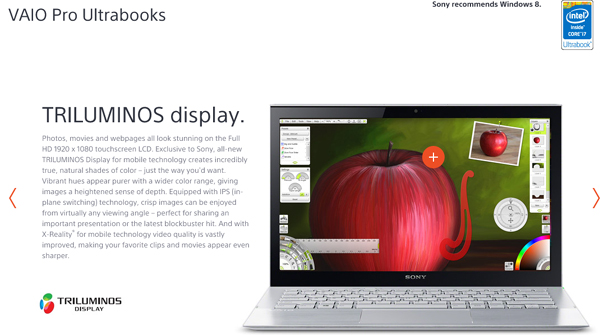
 Then, if you looked closely in the Sony booth, you could see VAIO Pro Ultrabooks and Flip PCs with Triluminos displays So much for conventional wisdom. Sony wasnt making much fuss about the Triluminos displays in its high-end notebooks at CES, but the opposite is true on the Sony Store website. The Triluminos displays appear to be available on the 11.6- and 13.3-inch VAIO Pro Ultrabooks and on the 13.3-, 14-, and 15.5-inch Flip PCs. All of these displays are Full HD. By the way, in addition to having a FHD Triluminos display, the Sony VAIO Flip sports a very clever slide-and-flip mechanism for converting between PC, tablet, stand, and easel configurations.
So, what has happened to change the conventional wisdom? Nanosys tells me that if all things were equal, the conventional wisdom might apply, but that QD Vision has to use a greater density of QDs than 3M does, so the cost difference in large screens is less than was originally anticipated. I do not yet have an answer for the opposite question: Why is it economical to use the Color IQ element for smaller screens? I hope that QD Visions Seth Coe-Sullivan will be answer that question at the SID Los Angeles Chapters One Day Symposium on Advanced Television Technologies being held February 7 at the Costa Mesa Country Club (http://www.sid.org/Chapters/Americas/LosAngelesChapter/Symposium.aspx). 3Ms Eric Joste will also be speaking. Gentlemen, now you know some of the questions we will be directing your way in Costa Mesa.
Ken Werner is Principal of Nutmeg Consultants, specializing in the display industry, manufacturing, technology, and applications. You can reach him at [email protected].