
3DTV - Are Competing Technologies Necessary? Including Auto-stereoscopic?
At the beginning of any new technology the first products are usually immature and expensive. A complex technology such as auto-stereoscopic glasses-free 3D cannot be expected to be at its best when introduced, and so far we have seen just prototypes of the large screen TVs.
On the other hand, the 3D technologies that require glasses, such as the active-shutter type or the theater like polarized glasses, got introduced to consumers at retail just recently and while they are expected to continue improving as new models are introduced, the technologies for the home are at their first stages.
Those that may have witnessed the HDTV introduction in 1998 may remember the first generation of TV sets. Compared to today, they had relatively substandard video processing when upscaling analog TV broadcast or DVD to the higher resolution of the HDTV.
The HDTV broadcasts, including satellite, displayed by first generation HDTVs showed compression artifacts, freezes, pixelization, macro-blocking, and other image imperfections, which improved with time via upgrades, better broadcasting techniques/equipment, and newer HDTV models.
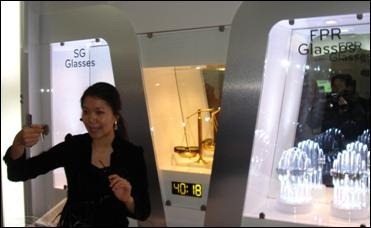
LG Display explaining their support for passive polarized 3D glassesRegarding consumer choice, the introduction of a variety of parallel display technologies such as DLP, LCoS, LCD, LCD with LED, Plasma, OLED, etc. facilitated the selection process so consumers find the right fit for quality, price, and applicability to their viewing environment.
Like all other consumer products, there may be reasons consumers could prefer the auto-stereoscopic 3D technology over the glasses-required alternatives (active-shutter and passive glasses), even when it may be more expensive at the beginning, but why should the pricing of auto-stereoscopic 3DTVs be comparable head-to head with glasses-required 3DTVs?
Couldn't it be possible for the various 3DTV technologies to coexist in parallel at their own price points to satisfy the different markets/purposes and the various requirements related to visual issues, group viewing at a reasonable cost, individual viewing habits, image quality, personal preference, etc.?
Some people may have reasons or limitations that may not allow them to view 3D with one technology but they may do with another. One technology may be offered at a good price but may produce a visual issue to a person that is sensitive to it. Another technology may not produce the visual issue to that person but he could not afford it so he may consider enduring the visual issue, or not buy 3D. But there will be a person that is willing to consider the cost of a technology as secondary in order to avoid experiencing a visual issue to enjoy 3D.
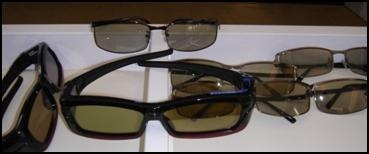
LD Display comparing active-shutter glasses with polarized glassesCould that person be you? Could the type of glasses, or the shutters, or the flicker, or the lower brightness, or the size of the glasses, or the visual isolation, or the lower resolution, or the cost, or the batteries, or kids handling expensive glasses, or any other known issues affect you differently than your neighbor? Certainly could. We are all different.
Ironically, because different technologies are being implemented for 3DTV, some asserted that unnecessary confusion could cause their self-elimination if consumers decide they'd rather not buy 3D at all when not knowing what to buy.
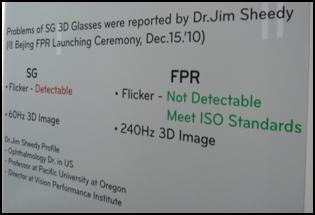
LG Display comparing features of 3D glasses technologiesThe industry has experienced HDTV technology confusion since 1998 with TVs having multiple resolutions, sizes, display types, DVI, HDMI, component analog, tuners, monitors, CableCARD, etc., however, over 150 million DTV sets of the various parallel technologies were sold to consumers in the last decade, only CRT was left behind (but some companies still sell CRTs).
I actually see the choices of 3DTV technologies as alternative solutions to personal, visual issues, and preferences people naturally have, especially with immature technology as 3DTV. A consumer may not tolerate the flicker of active-shutter (SD) technology but may accept passive technology with polarized glasses (FPR) at half resolution and still have the chance of enjoy 3DTV. The opposite can also be true.
The 3DTV adoption can be facilitated by having simultaneous technologies but retail stores must properly educate consumers about the features, differences, and applicability of those technologies to help them make the right decision. Consumer education was a major weakness with HDTV adoption. Hopefully the retail industry will not repeat the same mistake with 3DTV.
Should we see some practical examples of the timely value of simultaneous technologies?
Would you need to pay more for a 1080p HDTV when the pixels of a 720P HDTV would be imperceptible from your viewing distance? Perhaps even a cheaper 480p DTV may be enough because you will be viewing from the kitchen to the family room 20 feet away? Would you have preferred for the three technologies to be available in parallel to evaluate them at the store?
Would person “Y prefer to see at the store an LCD and a Plasma panel side by side to determine which one would be more appropriate for the bright apartment at the beach?
Person “X has specific screen size/viewing distance requirements for a home theater for which a 1080p projector would be the right choice, but only the 720p version was available, so he purchased it. Six months later the 1080p version that the manufacturer was having on hold was introduced, but it is too late for person “X. Would this person be pleased of having to sell a relatively new 720p projector at a loss to finally get the required 1080p version? Or be more pleased if both choices were available since the beginning?
Following the logic of some critics about the confusion created by parallel technologies claiming that they would eliminate themselves, 720p projectors/panels would not have sold if 1080p versions existed, but they still sell after a decade, and both technologies still have parallel markets at their respective price points.
Regarding the variety of HDTV display technologies mentioned above, such as DLP, LCD, LCD with LED, plasma, LCoS, OLED, and the abandoned CRT, could that parallelism have created confusion that produced their mutual elimination? No. Their parallel existence actually facilitated choices so consumers could achieve the best image quality for the particular viewing environments and user requirements at different price ranges.
Next article: 3DTV Technologies - Which one for you?