
articles
IPTV Part 6 - More Implementations and Final Thoughts
The following article is the latest in the IPTV series by Rodolfo La Maestra. Other articles in this series are as follows:
 Sony Internet TV System
Sony announced a new IPTV product at CES 2007, the Bravia Internet Video Link.
The module would seamlessly have Sony's new BRAVIA LCD panels receive Internet video streaming content, including HD, from providers like AOL and Yahoo! which portals support the Video Link.
The content is received without connecting the TV to a PC.
The module was planned to be available in the summer of 2007 and connects to the Bravia TV set with an HDMI cable and to a high-speed data modem with an Ethernet cable.
"The service itself will be free to consumers, as the ad-supported content should benefit from the exposure", said Nick Colsey, Sony's director of product planning for televisions.
At CES Sony demonstrated the module receiving streaming HD content, but Sony commented that "broadband speeds would have to improve significantly before HD over the Internet becomes reality, the appeal of the Internet Video module is based more on convenience than image resolution, it's not just quality, it's about having access".
TAVI 030
A surprising entry at CES 2007, and also an innovation award winner, was the TAVI 030 portable IPTV STB. The TAVI 030 is the follow-up to the TAVI 020 model, which brought little fanfare at CES 2006. This year TAVI is including IPTV into this portable solution.
Users can dock the TAVI at home, receive and record IPTV (and RSS delivered content), watch it at home, or simply undock the unit and watch it on the go. The 030 sports a 30GB (or 60GB) hard drive encased in a piano-black clamshell design which can output content at 720p using component connections and 5.1 audio using Toslink. www.tavi.com
UTStarcom
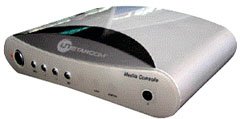
RollinStream Media Console for IPTV
IPTV STB with UWB wireless
Sony Internet TV System
Sony announced a new IPTV product at CES 2007, the Bravia Internet Video Link.
The module would seamlessly have Sony's new BRAVIA LCD panels receive Internet video streaming content, including HD, from providers like AOL and Yahoo! which portals support the Video Link.
The content is received without connecting the TV to a PC.
The module was planned to be available in the summer of 2007 and connects to the Bravia TV set with an HDMI cable and to a high-speed data modem with an Ethernet cable.
"The service itself will be free to consumers, as the ad-supported content should benefit from the exposure", said Nick Colsey, Sony's director of product planning for televisions.
At CES Sony demonstrated the module receiving streaming HD content, but Sony commented that "broadband speeds would have to improve significantly before HD over the Internet becomes reality, the appeal of the Internet Video module is based more on convenience than image resolution, it's not just quality, it's about having access".
TAVI 030
A surprising entry at CES 2007, and also an innovation award winner, was the TAVI 030 portable IPTV STB. The TAVI 030 is the follow-up to the TAVI 020 model, which brought little fanfare at CES 2006. This year TAVI is including IPTV into this portable solution.
Users can dock the TAVI at home, receive and record IPTV (and RSS delivered content), watch it at home, or simply undock the unit and watch it on the go. The 030 sports a 30GB (or 60GB) hard drive encased in a piano-black clamshell design which can output content at 720p using component connections and 5.1 audio using Toslink. www.tavi.com
UTStarcom
RollinStream Media Console for IPTV
IPTV STB with UWB wireless
 UTStarcom http://www.UTStar.com/ (IPTV)
and Tzero Technologies http://www.tzerotech.com/site/ (UWB)
as partners introduced their solution of IPTV STBs at the ITU Telecom World 2006 show in Hong Kong.
The STB is capable of over 500 MHz of bandwidth, suitable for simultaneously transmit several streams of uncompressed HD video.
Tzero's UWB is WiMedia Alliance based and is compliant with other WiMedia-compliant devices.
Verizon
Verizon currently offers unicast VOD from a library of about 3,000 titles through its Verizon FiOS TV service.
Verizon calls the service "narrowcast IP environment", and is expected to supply FiOS programming to about 1.8 million households by the end of this year.
FiOS TV was quoted as offering an average of 450 linear broadcast channels to the market, 25 of those are in HD. More HD programming is planned in the near future.
Verizon FiOS TV service was also planned for 316 communities in New Jersey, about 2.1 million households equivalent to 70% of the homes in NJ, according to Verizon.
Verizon FiOS TV service was also offered in Massachusetts (Lexington, Tyngsboro and West Newbury) and Delaware (Kent, New Castle, Sussex counties, Bellefonte, Delaware City, Newark, Odessa and Townsend).
"We will soon serve more communities in New Jersey than any of the current cable-TV operators have served in the past three-and-a-half decades," declared Dennis Bone, president of Verizon New Jersey.
Analysis of the Verizon Alternative
I contacted Verizon's Providence technical office to obtain details about the system:
UTStarcom http://www.UTStar.com/ (IPTV)
and Tzero Technologies http://www.tzerotech.com/site/ (UWB)
as partners introduced their solution of IPTV STBs at the ITU Telecom World 2006 show in Hong Kong.
The STB is capable of over 500 MHz of bandwidth, suitable for simultaneously transmit several streams of uncompressed HD video.
Tzero's UWB is WiMedia Alliance based and is compliant with other WiMedia-compliant devices.
Verizon
Verizon currently offers unicast VOD from a library of about 3,000 titles through its Verizon FiOS TV service.
Verizon calls the service "narrowcast IP environment", and is expected to supply FiOS programming to about 1.8 million households by the end of this year.
FiOS TV was quoted as offering an average of 450 linear broadcast channels to the market, 25 of those are in HD. More HD programming is planned in the near future.
Verizon FiOS TV service was also planned for 316 communities in New Jersey, about 2.1 million households equivalent to 70% of the homes in NJ, according to Verizon.
Verizon FiOS TV service was also offered in Massachusetts (Lexington, Tyngsboro and West Newbury) and Delaware (Kent, New Castle, Sussex counties, Bellefonte, Delaware City, Newark, Odessa and Townsend).
"We will soon serve more communities in New Jersey than any of the current cable-TV operators have served in the past three-and-a-half decades," declared Dennis Bone, president of Verizon New Jersey.
Analysis of the Verizon Alternative
I contacted Verizon's Providence technical office to obtain details about the system:
- There could be up to 7 HD STBs tuning in parallel at the home,
- The live HDTV service is not running over IP but over a separate coax,
- VOD runs over IP using a parallel coax connected to a router inside the house,
- Each VOD request is channeled thru the router, which is connected to the Fiber Optic box installed outside the house,
- The VOD movie request is redirected to the central hub at Verizon,
- The hub downloads the requested movie into a server dedicated for that purpose (for each house I was told), the download takes about 7-10 minutes,
- The video can be viewed instantly and while the movie is being downloaded to the server; Verizon said that the starting is much faster than cable VOD.
- Additional parallel VOD movie requests from other STBs "could" induce image speed delays during the first 7-10 minutes of the Hub/server download, so it is recommended for the additional VOD requests to wait that time for seamless viewing.
- The home network for both TV and VOD IPTV is usually based on coax.
- The compression algorithm used is MPEG-4,
- The system uses Moxi, and they said they were working in newer and better software, to be available soon.