The following article is the latest in the IPTV series by Rodolfo La Maestra. Other articles in this series are as follows:
This company introduced an IP/Complete IPTV-delivery system targeted to small-scale Telcos.
The system features 145-channel selection, including 30 HDTV channels for 2007, and 4 local off-air HD channels; secured/encrypted signal throughout, single on-site relay rack, emergency-alert system standard across all channels.
BPS Telephone in Bernie, Mo. was aligned to become a service provider using the system.
Minerva Networks/Siemens/Espial
CES 2007
MyTVPal.com
In November 2006, the company said they were launching North America's first 1080P High Definition IPTV service for streaming VOD and IPTV service using PC Player and IPTV receiver set top box (STB) clients from MatrixStream (mentioned above).
During 2007 the company expects to launch HD 1080p services and HD STBs to 100,000 subscribers, and grow to about 10 million users within the next 5 years. The company offers the PC Player for a free trial upon registering at
www.MyTVPal.com
MyTVPal PC player is designed to allow any PC user to watch many different TV broadcasts and listen to many radio stations from around the world, as well as providing the ability to play HD videos via XMS streaming technology.
The lineup includes over 700 free IPTV SD and HD channels from over 70 countries, requiring a minimum of 1.5mbps speed or higher of network capacity. The company has plans to add more VOD titles and channels every month.
Features such as user uploaded content, DVR, and software upgrades for PC and STB clients are also planned during 2007.
The following are the minimal system requirements on the PC to play different videos on the latest beta MyTVPal player:
|
Pentium 4 - 2.4 GHz or higher
512 MB Ram
256 MB Video Card or Better
Broadband Speed 1.5 Mbps or faster
Windows 2000/Windows XP or VISTA | Dual Core 1.6 GHz or better
512 MB Ram
256 MB Video Card or Better
2.5 Mbps Broadband Speed or Better (3 Mbps recommended)
Windows XP or VISTA | Dual Core 2.0 GHz or better
1 GB Ram
512 MB Video Card or Better
5 Mbps Broadband Speed or Better (6 Mbps recommended)
Windows XP or VISTA |

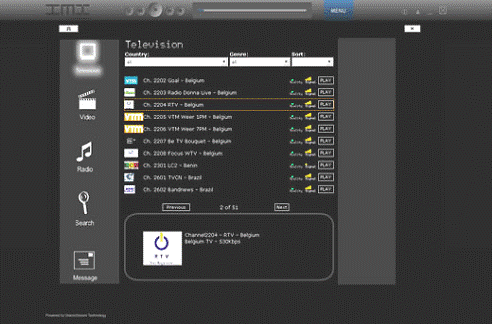
Sample Screen Shot of MyTVPal Video Player
In September 2006, Canada's SaskTel launched an HD IPTV service (Max HD Ultimate) over an IP network in North America. SaskTel is a government owned telecommunications company servicing the Canadian province of Saskatchewan.
The company said it had 45,000 IPTV subscribers out of the 425,000 clients for telecommunication services in 13 cities, 535 smaller communities and surrounding rural areas, including 49,000 farms.
Alcatel and Motorola's VIP1200 HD/H.264 set-top box are implemented in the service, as well as Kasenna's MediaBase media-streaming software, and Widevine Technologies' digital-rights-management system.
The service offers 27 HD channels, 35 Saskatchewan radio stations, high-speed-Internet service, video-on-demand, and other content, for $59 Canadian Dollars per month for an initial period of 4 months. The company plans a PVR service for early 2007.
HD movies from major studios such as NBC Universal, Paramount, Sony Pictures, Twentieth Century Fox and Warner Bros. were announced within the service, as well as TSN, Sportsnet, Discovery Channel, and other specialty channels.
www.sasktel.com
Analysis of information Sasktel does not advertise
When analyzing the technical aspects of the HD IPTV service of Sasktel, one starts to see the limitations of it. I talked to Sasktel's technical department to discuss the subject and the following is a brief analysis:
Sasktel installs fiber wiring up to the street cabinet from where two regular copper phone lines run to the house. The two lines entering the house max out at 14Mbps each.
One is reserved for HD services using MPEG-4 compression and the other is reserved for SD STBs (MPEG-4 as well) and DSL services. That 2nd line is shared by a maximum of 4 SD STBs plus 1.5 Mbps DSL, or up to 7 Mbps DSL with less number of SD STBs, depending on the package. The HD line is not shared and it carries only the selected HD channel.
Sasktel uses Pace and Motorola STBs. Perhaps by April they would have a DVR STB.
The main drawback about this system is that only 1 HD channel can be tuned in the entire house no matter how many HDTVs you might have in the house. If you thought about using the 2nd line for an extra HD tuning, forget it, the second line cannot be used for another HD feed (in lieu of the standard SD / DSL service).
The 4 SD STBs for the 2nd line can tune different programs simultaneously.
Here is a second catch, if one requests a VOD SD program and a second SD STB in the house also wants the same VOD movie but a while later, it has to share the same running stream and view the movie as already started. It cannot initiate a separate VOD stream of that same movie to run in parallel at a different timing of the active stream. Some families might not even care about that limitation, some would.
The IPTV system is certainly open and flexible for the addition of more channels without being concerned about bandwidth issues of typical MSOs, but the limitation of no-parallel HD viewing at home could be a problem for many people.
At similar price conditions, many subscribers might put more value on being able to view multiple HD feeds than having the network flexibility to expand to another 100 channels which subscribers might not even have the time to see all.
Some people might be attracted to having a thousand channels, and if they have only one HDTV and live alone, the system might be perfect for their situation. However, a few years from now, it will be more common to have several HDTVs in a single family home, and using this solution, if one HD STB is already tuning an HD channel, the other HDTVs would be confined to display only the SD version of an HDTV program, or display only SD channels.
There will be future opportunities to improve the compression efficiency for this (or similar) IPTV system, which could make it eventually capable to offer parallel HD channels over the same pipe. However, this same future of more efficient compression algorithms could also benefit the growth of cable and satellite, which could offer more HD channels when using less space.
In both cases the systems would have to run the risk of eventual STB replacement if the new compression algorithm is not supported by the current STB design, like MPEG-2 STBs suffered when MPEG-4 was introduced by DirecTV and Dish Network.
Although those traditional systems have their own limitations of bandwidth, they already offer hundreds of channels. How many more you need? They also have dozens of HD programs for the viewer to watch in parallel at home today.
Additionally, when comparing this IPTV implementation with satellite, cable, and even regular broadcast, having the flexibility to view parallel HD programs might not be a point of negotiation at any price for some subscribers.
The price of this IPTV solution is not necessarily a bargain at $52 dollars a month for just the basic SD service (after the first 4 months), adding the HD services on premium channels the monthly bill gets closer to $100 per month. Cable and Satellite are not so different in price for that lineup.
Regarding technical problems of the implementation, the company had some technical problems with the feeds, but in general, they received 80% HD subscriber acceptance on a recent survey.
In the 6th and final article I include more implementations and some final thoughts about adopting IPTV.
Next Article:
IPTV Part 6 - More Implementations and Final Thoughts